


Amazon lets almost anyone start selling. Walmart does not. You apply first, and Walmart decides whether you qualify.
That gate is part of the appeal for sellers. Fewer sellers per listing can mean less competition for visibility. But getting approved is the hard part.
Sellers asking how to sell on the Walmart Marketplace often start with the fees. Walmart starts with the paperwork. You need a registered business, product barcodes, and a way to handle returns in the US. Walmart checks these requirements before your first listing goes live.
Once you clear that step, the cost of entry is low. There is no sign-up or monthly fee. Instead, Walmart takes a share of each sale.
This guide covers the full process, from applying to getting paid. You’ll see what Walmart takes from each sale, what fulfillment costs, and why your first payment can take longer than expected.
Key Takeaways
- Walmart approves sellers rather than accepting them, so you must meet every requirement before you can sell.
- Fewer sellers can compete for the same listing, which can make visibility less crowded than on open marketplaces.
- Your product category sets the fee, and some categories change the rate once the price crosses a line.
- Listing costs nothing until something sells, so you can test the channel without spending first.
- Walmart handles delivery when it ships your orders, but customer reviews can still affect your seller account.
- The Buy Box is decided per location, so one listing can win in one region and lose in another.
- New sellers may wait around three months before payouts move to the normal schedule.
Table of Contents
What is Walmart Marketplace?
Walmart Marketplace is a platform where independent businesses sell their own products on walmart.com, alongside the items Walmart stocks itself. These businesses are called third-party sellers. Shoppers browse a single catalog, with the seller’s name shown on the product page.
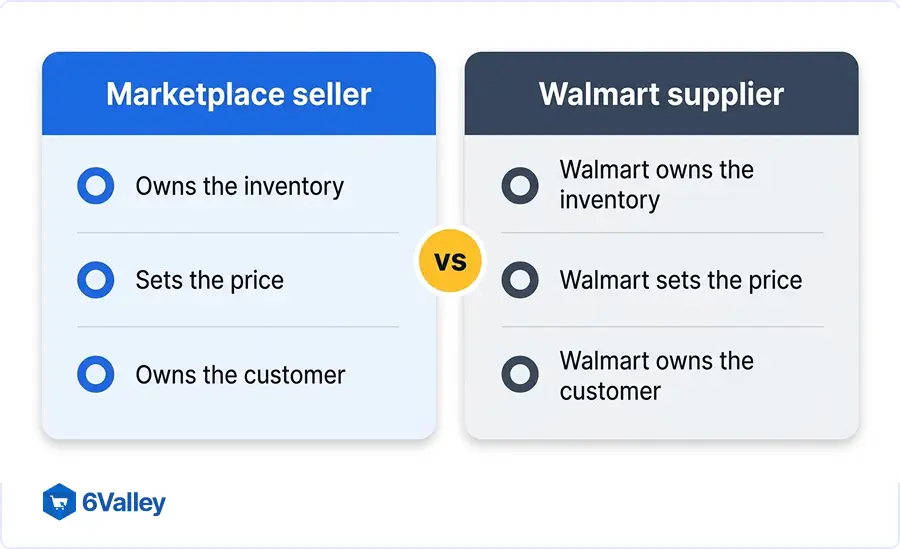
Selling on Walmart Marketplace is different from supplying Walmart. The key difference is who owns the inventory and controls the sale.
As a supplier: You sell your inventory to Walmart. Walmart owns it, sets the selling price, and handles the customer relationship.
As a marketplace seller: You keep the inventory and set the selling price. You handle the customer relationship, while Walmart takes a fee from each sale.
Marketplace is usually the faster way to start selling. A supplier deal goes through Walmart’s buying team and can take months.
A marketplace application involves paperwork and a catalog upload, with a decision often coming within weeks. Both routes put your products in front of Walmart shoppers.
Why Sell on Walmart Marketplace?
Walmart is one of the few large marketplaces where a new seller can still get found without paying for every click. The audience is already there. The number of sellers competing for it is smaller.
Marketplace Pulse estimates Walmart’s marketplace GMV at roughly $15 billion. That is about 10% of Walmart’s $150 billion US e-commerce business. Amazon’s marketplace accounts for an estimated 69% of its US GMV, according to the same report.
Walmart still sells most of its products itself. Its third-party marketplace is much younger by comparison, giving new listings access to a marketplace that is still growing.
Less Seller Competition Than Amazon
Walmart.com has far fewer third-party sellers than Amazon. That means fewer sellers compete for visibility on the same product pages.
Sellers who use both platforms report a similar difference. One r/WalmartSellers poster with six years on Amazon and three on Walmart said Walmart had less competition, while Amazon generated more sales volume.
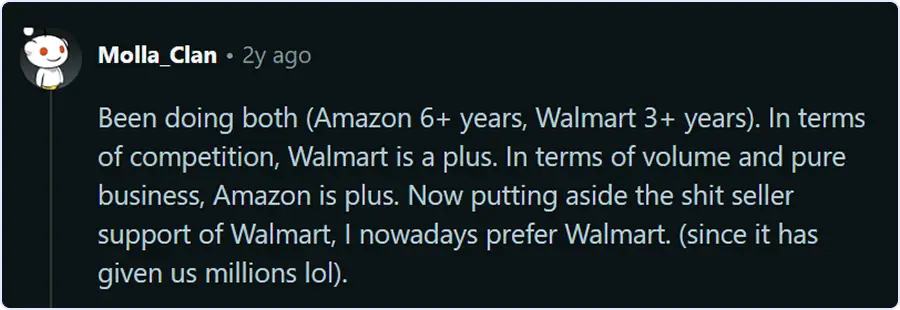
The seller also said they had never run Walmart ads because their listings sold without them. This is one seller’s experience, not a marketplace-wide measure, but it aligns with Walmart’s smaller seller base.
No Monthly Fee to Start Selling
Walmart does not charge a sign-up or monthly fee. You pay when an item sells.
- No setup fee: Applying and getting approved costs nothing.
- No subscription: There is no monthly fee to keep your account open.
- No listing fee: Your products can stay listed without generating a sale.
That lets you test Walmart alongside your existing sales channel without committing to a monthly cost. If sales start slowly, you are not paying a platform fee while you wait.
Walmart’s Built-In Shopper Traffic and Brand Trust
Shoppers on Walmart.com are already looking for products, so sellers can reach customers without first building traffic to a new website.
Trust comes with it. Customers already know Walmart’s checkout, returns, and customer service. For a new brand, selling through Walmart can make the buying process feel more familiar than purchasing from an unfamiliar store.
Fast Delivery Without Building a Warehouse
Walmart Fulfillment Services (WFS) stores, packs, and ships your orders. WFS listings can also qualify for delivery badges, giving you faster fulfillment without running your own warehouse or hiring a fulfillment team.
WFS also handles much of the delivery process for you, including shipping and customer support for WFS orders. That can make it easier to manage orders as your sales volume grows.
In-Store Pickup and Returns
Walmart’s store network gives marketplace sellers a returns option that an independent website cannot easily match. Customers can return eligible marketplace items to a Walmart store, where the return and refund are handled before the item is sent to the Marketplace Return Center for processing.
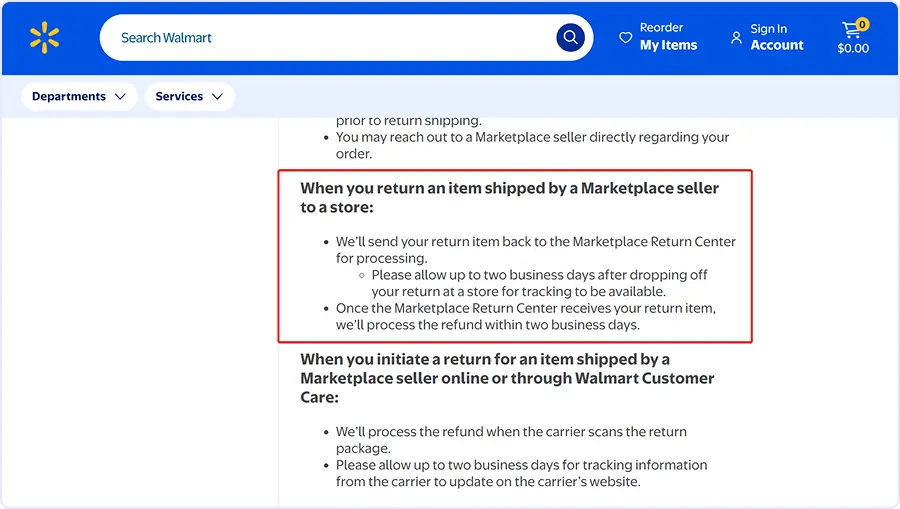
For customers, that makes returns more convenient. For sellers, it adds Walmart’s store network to the returns process without having to build one yourself.
What Can You Sell on Walmart Marketplace?
Most general retail categories are open to third-party sellers. The real question is which ones need approval first. These are the products you can list as soon as your account opens, with no extra paperwork.
- Home, kitchen, and furniture
- Apparel, shoes, and accessories
- Electronics and computers
- Toys, baby, and games
- Beauty, health, and personal care
- Pet supplies, sporting goods, and auto parts
Some categories need extra approval before you can list them. Walmart may approve a specific brand or product, so approval for one item does not automatically cover the rest of your catalog.
These categories may require approval:
- Books, software, and custom content
- Fragrances and luxury brands
- Ingestible and topical products
- Class II and other restricted medical devices
- Halloween and select seasonal products
- Jewelry, watches, gemstones, currency, coins, and precious metals
Approval can also apply to specific products within categories that are generally open. Some over-the-counter drugs, dietary supplements, personal care and beauty products, pet products, and baby products need extra approval before you can list them.
Walmart groups these rules under its Prohibited Products Policy. But being listed in the policy does not always mean a product is banned. Some products are prohibited, while others are allowed if you meet Walmart’s requirements or get approval.
The outright bans are the ones to check first.
- Alcohol in any form, including powdered and non-alcoholic versions
- Tobacco, e-cigarettes, and all vaping products
- Firearms, firearm parts, and ammunition
- Realistic toy guns and imitation firearms
- Recalled products and hazardous materials
- Used, pre-owned, and refurbished goods
The used-goods ban catches sellers out most often. Walmart accepts new-condition stock only, unless it invites you into its Resold program.
Read the policy before you build your catalog. Pre-approval means sending Walmart documents and waiting on a decision, and most sellers discover that only when an upload fails.
A qualifying product is only half the test. The business behind it has to qualify too.
Walmart Marketplace Seller Requirements
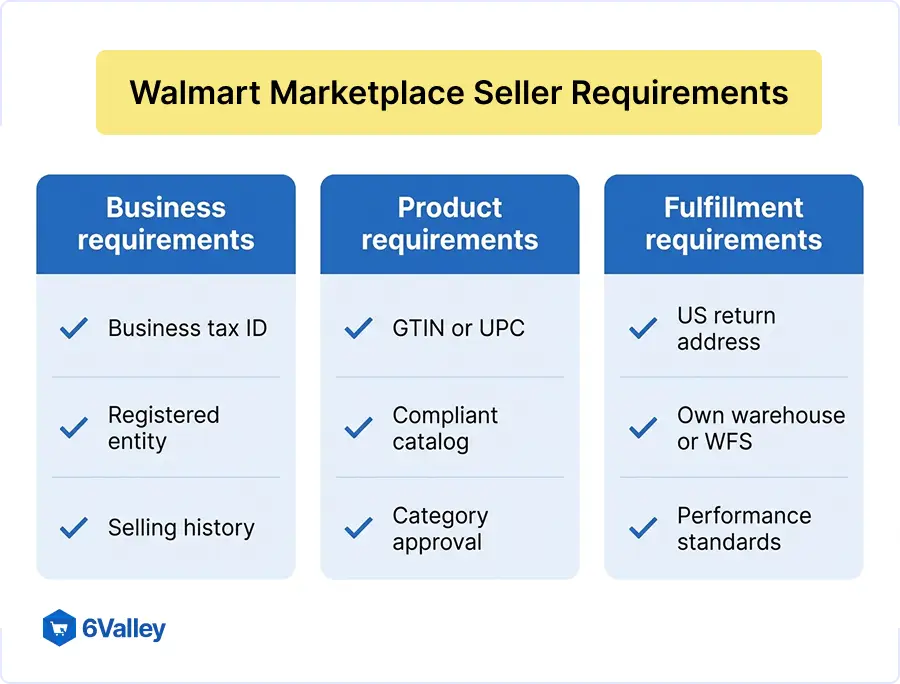
Walmart publishes a minimum requirements list, and every approval requirement on it is checked before your account opens. The requirements cover your business, products, and shipping. A missing document or information that does not match your records can stop your application.
Business Requirements
You apply as a registered business. Individuals cannot sell here, and Walmart verifies every detail against government and IRS records before it opens the account.
- Business tax ID: An EIN issued by the IRS. A Social Security number cannot replace it.
- Accepted business type: A corporation, partnership, or LLC taxed as one of them. Nonprofits and single-member LLCs cannot be selected during onboarding.
- Tax form: A W-9 for US businesses or a W-8 for businesses incorporated outside the US.
- Business name and address: Your documents must match your legal and tax records.
- Personal ID: A photo ID for the applicant or legal representative.
- Selling history: Proof of previous sales through another marketplace or your own store.
Make sure your business name matches your official records exactly. Even small differences can cause verification problems, so use the name shown on your IRS documents.
Choose your business entity carefully because you cannot change it after onboarding.
Product Requirements
Every product needs a recognized identifier, and your catalog must meet Walmart’s product requirements before you can list.
- GTIN or UPC: Product identifiers issued through GS1.
- Compliant catalog: Your products must follow Walmart’s Prohibited Products Policy.
- Category approval: Some categories need approval before you can list products in them.
Walmart reviews your catalog during the application process. If you plan to sell products in a category that requires approval, you need to clear that approval before listing those products.
Fulfillment Requirements
You need a US setup that can handle returns. Walmart gives you two options:
- Your own US warehouse: It must accept returns and meet Walmart’s Seller Performance Standards.
- Walmart Fulfillment Services: WFS stores, ships, and handles returns and customer support for you.
WFS does the work of processing a return, but you may still pay for it. Walmart waives the return processing fee when it determines that Walmart was at fault, according to its WFS fee schedule. Other returns are charged to your account.
If the seller is at fault, you also lose the sale. Walmart reverses the original sale amount and refunds the referral fee, but the fulfillment fee already charged is not refunded.
How to Sell on Walmart Marketplace Step by Step
Setup happens in Seller Center after your business qualifies. Each step unlocks the next. Your payment method must be approved before you can set up shipping. Those shipping settings then decide the delivery date shoppers see on your listings.
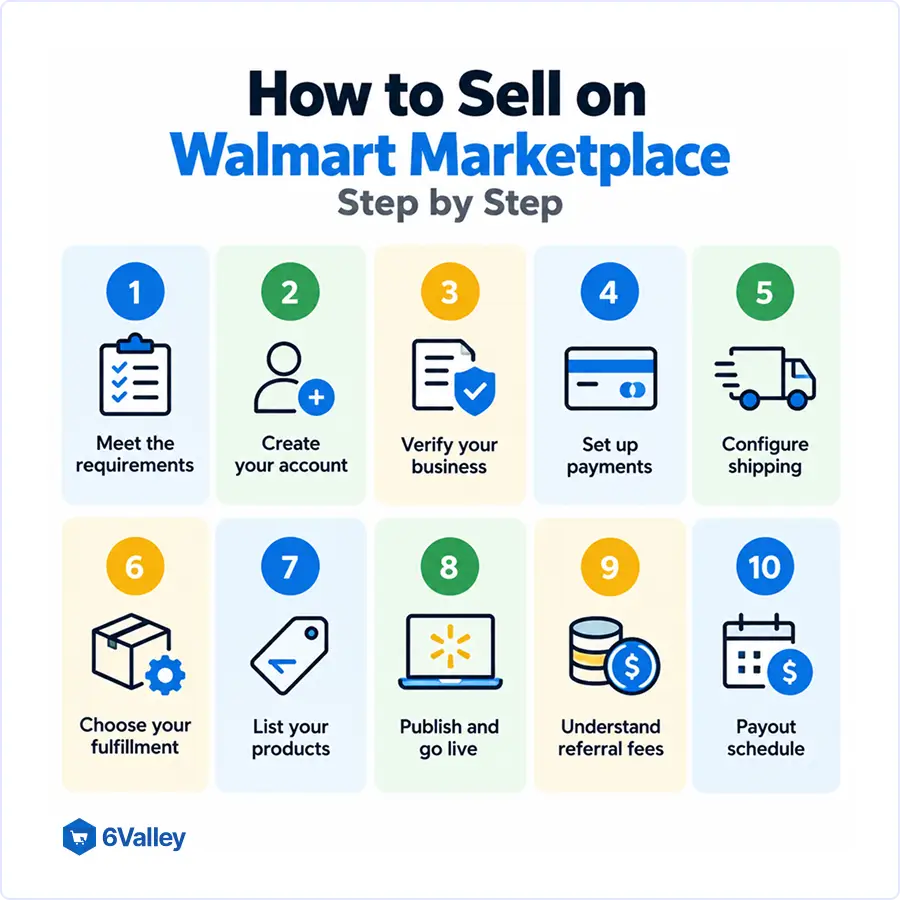
Meet the Walmart Seller Requirements
Have your EIN, tax form, barcodes, and US returns setup ready before you apply. Walmart checks these details during the application, so an incomplete business profile can stop the process before setup begins.
Create Your Seller Account
Walmart Marketplace applications open at marketplace.walmart.com, and the form itself takes minutes once your paperwork is in front of you paperwork is in front of you.
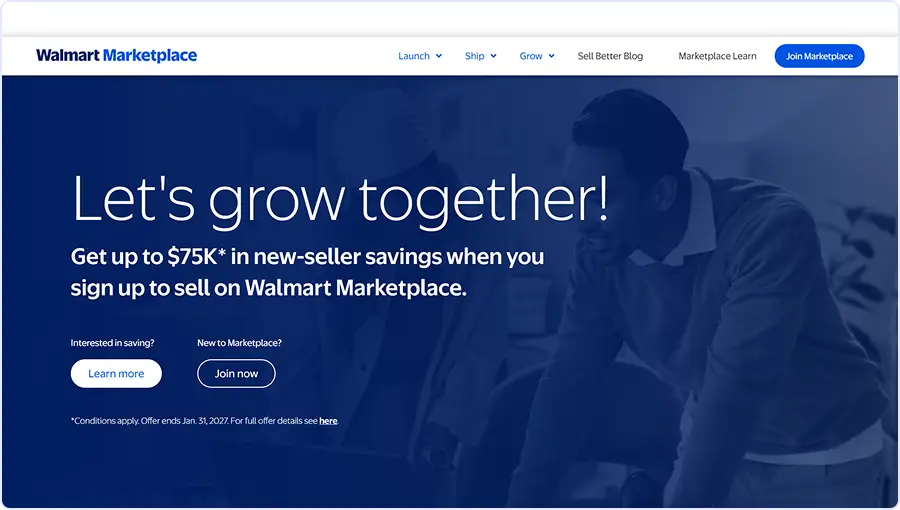
Have these ready before you start:
- Business email: Use a business email with your domain instead of a personal account.
- Tax ID or business license number: The number used to register your business.
- Entity details: Your legal business name, entity type, and state of registration.
- Existing marketplace login: Only needed if you plan to import your catalog.
Your marketplace login determines how you set up your account. Express setup lets you import your business details and existing listings from another marketplace. This can save time if you have a large catalog. Without it, you’ll need to add your catalog yourself later.
Verify Your Business
Walmart checks your business details against government records before opening your account. If the information matches, verification can take just a few minutes.
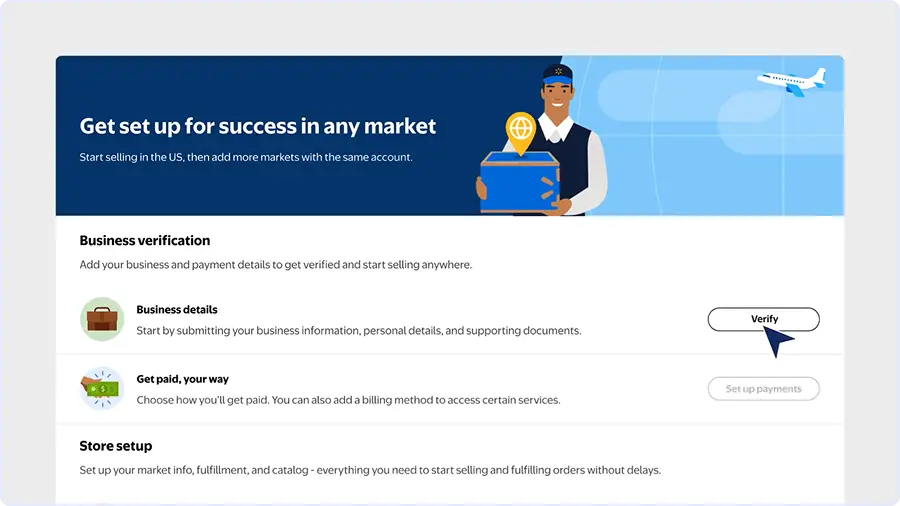
Enter your legal business name, entity type, phone number, and state registration or business license number. Then upload a photo ID for the applicant or legal representative.
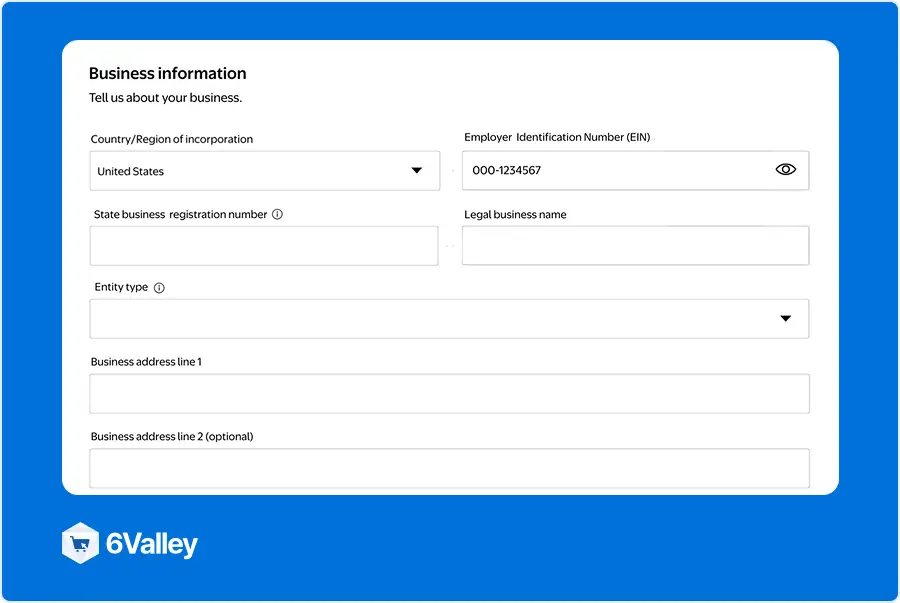
If your information does not match your records, verification can take longer. Walmart may also ask you to verify your identity separately through a third-party service. You’ll scan your ID and face using your device camera.
You have seven days to complete this step after Walmart sends the notification. If you miss the deadline, Walmart may close the account, according to its business verification guide.
Set Up Payments
Walmart does not pay directly into your bank account. Your payouts go through a payment provider first, which you choose during setup.
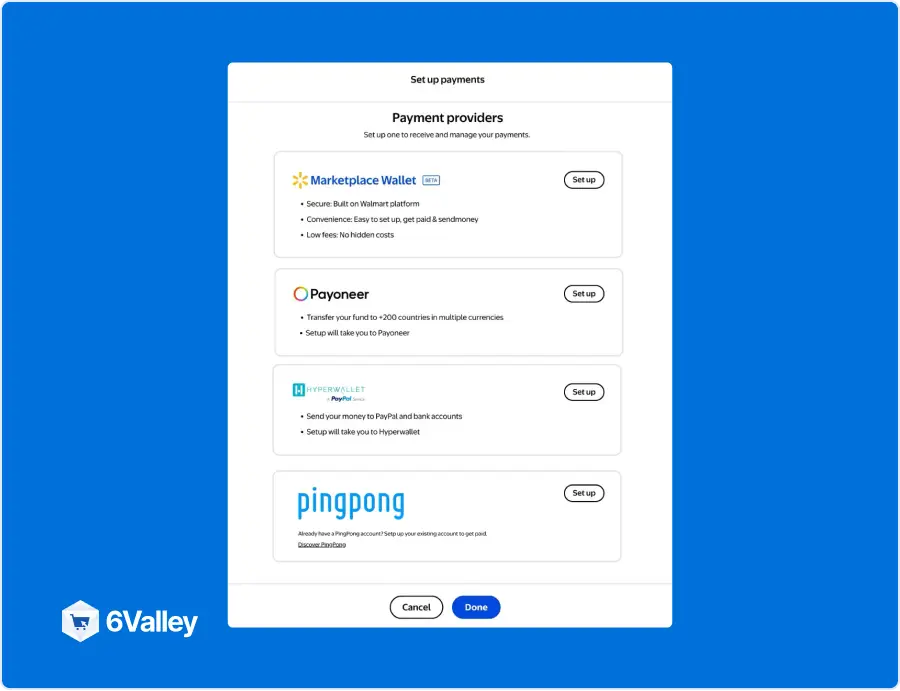
Your payment options depend on where your business is incorporated.
- Marketplace Wallet: A deposit account built into Seller Center for US-incorporated sellers. You do not need to connect an external provider.
- Third-party payout provider: Walmart lists Payoneer, Hyperwallet, and PingPong for US sellers. Sellers in some other countries may have options such as LianLian, Airwallex, and WorldFirst.
Both options pay you the same way. The difference is where your money is held before you transfer it.
Marketplace Wallet holds your funds in Seller Center until you transfer them. A third-party provider holds the funds in its account, and you transfer them to your bank from there.
Choose one option and stick with it. Walmart allows only one payout provider at a time.
The deadline is firm. You must complete payment setup within 30 days of submitting your business details. If you miss the deadline, Walmart declines the application, and you must start the application again.
Configure Shipping and Returns
Your shipping settings determine the delivery date shoppers see on your listings. They also affect how much you charge for shipping.
Every seller must offer at least one shipping method, according to Walmart’s shipping methods guide.
- Value, 6 to 7 days: The default option on every account. Always free for customers.
- Standard, 3 to 5 days: Optional. You can charge for it or offer it for free.
- TwoDay, 2 days: Requires access through Seller Center.
- OneDay, 1 day: Requires access through Seller Center.
- Freight, 6 to 10 days: For oversized and heavy items.
Charging for Standard shipping can affect your listing. According to the same guide, items with paid Standard shipping lose their search boost and Buy Box prominence.
Next, set up your returns. You need a verifiable US return address, regardless of which fulfillment method you use.
You can let Walmart calculate transit times, which gives you protection against carrier delays. Or you can set your own times and control your return labels, return centers, and cutoff times.
You can edit these settings later from your Shipping Profile.
Choose Your Fulfillment Method
You can ship orders yourself or use Walmart Fulfillment Services (WFS). Your choice affects your costs, delivery speed, and how much of the fulfillment work you handle.
Self-Fulfillment
- Best for: Sellers with their own warehouse, slow-moving inventory, or oversized items.
- Costs: You pay for storage, packing, and shipping. Walmart does not charge a separate fulfillment fee, but the referral fee still applies to each sale.
- The catch: You are responsible for meeting Walmart’s performance standards, including on-time delivery and valid tracking.
Walmart Fulfillment Services
- Best for: Sellers who want fast delivery without running their own fulfillment operation.
- Costs: Starting at $3.45 per unit shipped and $0.75 per cubic foot stored each month, according to Walmart’s WFS fee schedule.
- The catch: You pay monthly storage fees while inventory sits in WFS. Items priced below $10 also have an extra $1 per-unit fee.
Run your own numbers before choosing WFS. Walmart provides a WFS pricing page you can use to estimate your costs.
List Your Products
Walmart gives you several ways into the catalog, and the right one depends on how many items you are bringing across.
- Marketplace import: Pulls an existing catalog over from another platform.
- Single-item entry: Fine for a handful of products.
- Bulk spreadsheet upload: Available once account setup is finished.
- API or solution provider: Built for large or fast-changing catalogs.
- GTIN exemption request: For private label or handmade goods with no barcode.
Publish Your Listings and Go Live
Your products stay in draft until setup, inventory, and pricing are complete. This gives you a final chance to review them before they go live.
Check each listing on its product page, not just in your upload sheet. The product page shows how shoppers will see it.
- Titles: Check how they appear on mobile and make sure they are not cut off.
- Images: Make sure the main image meets Walmart’s requirements and looks clear at thumbnail size.
- Attributes: Complete the attributes used by your category filters so shoppers can find your products.
Fix any issues before publishing. It is easier to update a listing before shoppers start seeing it.
Publishing can take time after you add inventory. Walmart says account completion can take up to four hours, after which your products can be published.
If you use an API integration, test your order flow in Walmart’s developer sandbox before connecting it to live listings.
Understand Walmart’s Referral Fees
Walmart charges a referral fee on every sale. The fee applies to the total sales price, including shipping, handling, and gift wrap.
Walmart assigns your product to a contract category during setup, and that category determines your fee rate. The category you select when listing does not set the rate.
Most products have referral fees between 6% and 20%.
| Category | Referral fee |
| Personal computers | 6% |
| Consumer electronics | 8% |
| Most general merchandise | 15% |
| Apparel | 5% at $15 or less, 10% up to $20, 15% above |
| Jewelry | 20% on the first $250, 5% above |
Sources: Walmart Referral Fee schedule
Two categories use tiered rates, but they work differently. Apparel applies one rate to the full sale once the price crosses a threshold. For example, a $21 shirt would pay 15% on the full $21.
Jewelry uses separate rates for different parts of the sale. A $300 item would pay 20% on the first $250 and 5% on the remaining $50.
Check your assigned contract category during setup. That category determines your referral fee, so the wrong assignment can mean a significant difference in what you pay.
Walmart Marketplace Payout Schedule
Walmart pays sellers on a fixed settlement cycle, so your first payment may take longer than expected.
Three things determine when you get paid, according to Walmart’s payment activities guide:
- The cycle: Settlements run every two weeks and close on alternate Fridays at midnight Pacific Time.
- The waiting period: An order becomes eligible for payment seven or more days after it ships.
- The usual total: Walmart estimates that payment takes about 28 days from shipment in most cases.
For example, if an order ships on a Monday, it must first clear the seven-day waiting period. If it misses that week’s settlement cutoff, it moves to the next cycle.
New sellers may have an additional payment hold. Walmart can hold payments for up to 14 days for US businesses and up to 21 days for businesses incorporated outside the US. The hold can end after 90 days from your first shipped order and $7,500 in payments received from Walmart.
Walmart Seller Tools and Programs
Meeting Walmart’s baseline standards keeps your account in good standing. Stronger performance can also unlock seller programs and tools that help with pricing, shipping, financing, and product growth.
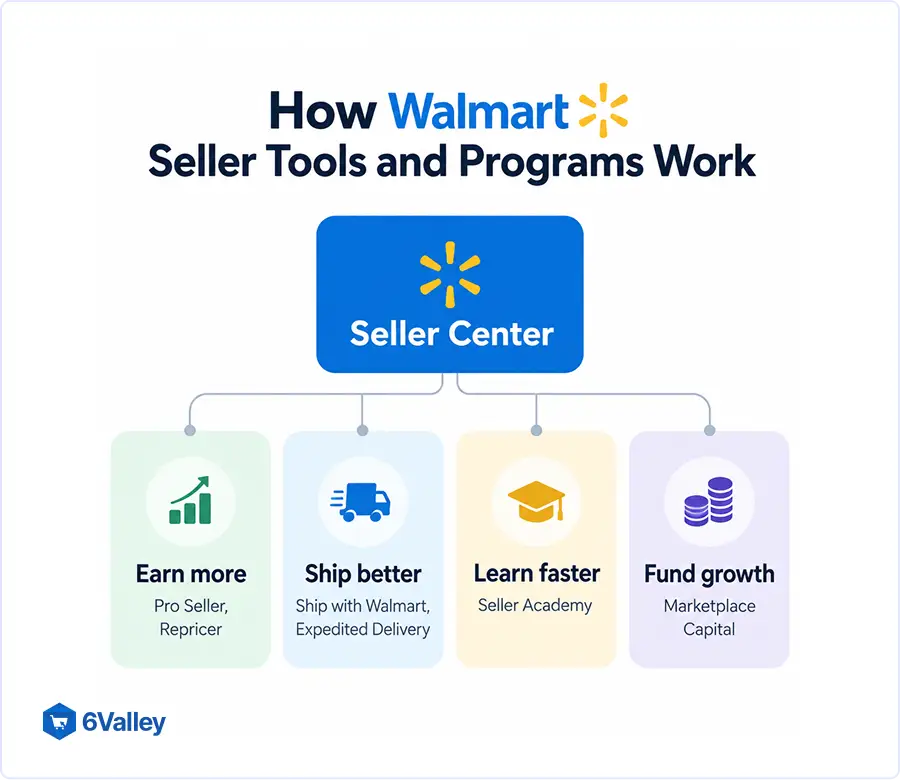
Walmart offers seller tools and programs through Seller Center, and most are free to use. Some become available only after you meet certain performance thresholds.
| Tool or program | What it does | Best for |
| Repricer | Adjusts your offers automatically against competing prices within strategies you set | Sellers competing for the Buy Box on shared pages |
| AI-Powered Listing Tool | Handles single and bulk item setup to cut time to market | Anyone uploading a catalog or adding items regularly |
| Smart Assistant | Answers operational questions in real time, around the clock | New sellers learning Seller Center |
| Customer Favorites | Flags in-demand items from Walmart’s own shopper data, inside the Assortment Growth dashboard | Sellers deciding what to add or prioritize next |
| Ship with Walmart | Supplies discounted carrier labels plus order protection through Seller Center | Self-fulfilling sellers paying retail carrier rates |
| Expedited Delivery | Adds OneDay, TwoDay, or ThreeDay tags that lift search placement and Buy Box wins | Sellers who can meet a faster delivery promise |
| Multichannel Solutions | Uses your WFS inventory to fill orders from your own site or another marketplace | Sellers running more than one sales channel |
| Marketplace Capital | Offers working capital on special terms to Advanced and Pro Sellers | Sellers short on cash during the payout wait |
| Pro Seller program | Grants referral fee discounts of 5% or 10% once you clear its performance tiers | Established sellers already hitting their metrics |
| Seller Academy | Provides free courses on listing, shipping, catalog growth, and account health | First-time sellers and new team members |
Sources: Marketplace Seller Summit announcement, Pro Seller program, Ship with Walmart, Expedited Delivery, Assortment Growth overview
Multichannel Solutions is worth setting up early. It keeps one inventory pool across Walmart and your other sales channels, reducing the risk of selling stock you have already sold elsewhere.
Marketplace Capital helps cover the gap between making a sale and getting paid, so you can restock without waiting for the payout.
Walmart Marketplace Fees Compared to Competitors
Walmart charges no setup fee, monthly fee, listing fee, or per-order fee. Its referral rates are similar to Amazon’s in many categories, so the percentage alone does not tell the full story. The difference comes from the other costs that sit around that percentage.
| Marketplace | Monthly or setup fee | Listing fee | Commission per sale | Fixed per-order charge |
| Walmart Marketplace | None | None | Category rate, no minimum | None |
| Amazon | $39.99 a month, or $0.99 per item sold | None | 5% to 45% by category | $0.30 minimum referral fee |
| eBay | None, store plans optional | Free to 250 a month, then $0.35 | 13.6% in most categories | $0.30 under $10, $0.40 above |
| Etsy | $15 to $29 one-time shop setup | $0.20 per listing | 6.5% transaction fee | 3% plus $0.25 payment processing |
Sources: Walmart, Amazon, eBay, Etsy
Amazon’s subscription fee matters more at low volume. At 10 orders a month, the $39.99 plan works out to about $4 per order before commission. At 1,000 orders, that drops to about four cents per order.
Walmart has no monthly subscription fee. You can also estimate WFS costs before applying, while Amazon’s FBA fees are available through Seller Central.
The difference matters most when you are starting small. Walmart lets you test sales without committing to a monthly platform fee.
How to Succeed as a Walmart Marketplace Seller
Succeeding on Walmart comes down to winning the Buy Box, maintaining strong performance metrics, keeping listings in good shape, and knowing when to pay for reach. Approval gets you in. These are what keep you visible.
Walmart tracks your performance based on factors such as pricing, delivery, and customer feedback. That performance can affect how your listings appear and whether they remain published.
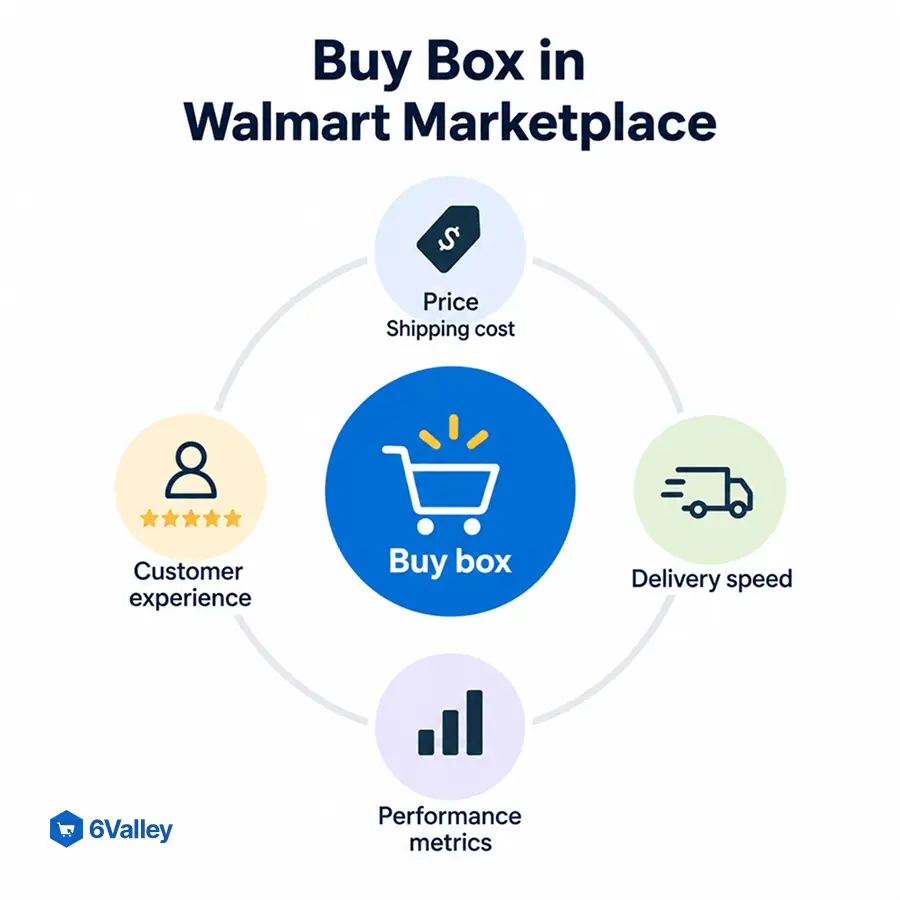
The Buy Box brings these factors together when Walmart decides which seller’s offer to show shoppers.
Winning the Buy Box
Only one seller gets the Add to Cart button on a shared product page. Walmart considers several factors when choosing which offer to show a shopper.
- Price: How your item price compares with other offers.
- Shipping cost: What the shopper pays for delivery.
- Delivery speed: How quickly the item can reach the shopper.
- Performance metrics: How your account compares with Walmart’s performance standards.
- Customer experience: Factors such as ratings, returns, and post-purchase service.
Location also matters, so the same listing can win the Buy Box in one area and lose it in another. A lower price alone does not guarantee the Buy Box.
You can use the Buy Box report in Seller Center to see which products are competing and how often you win.
Also Read: How to Choose the Best Multi Vendor eCommerce App?
Meeting Walmart’s Performance Standards
Walmart measures seller performance against set thresholds. The measurement period can be 30 or 60 days, depending on the metric, according to its seller performance standards guide.
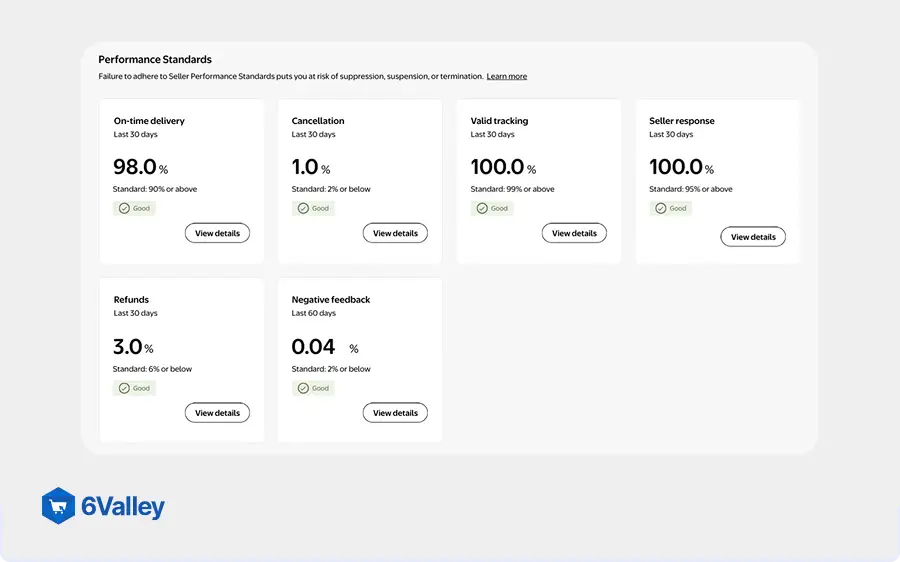
These are the main standards:
- Cancellations: 2% or below
- On-time delivery: 90% or above
- Valid tracking: 99% or above
- Customer replies within 48 hours: 95% or above
- Negative feedback rate: 2% or below, based on one- and two-star ratings over 60 days
Walmart also tracks refund rate, return rate, and item-not-received rate in Seller Center.
If you sell on multiple channels, keep your inventory in sync. Overselling can lead to cancellations when an item is no longer available.
What Happens if You Fall Below a Performance Threshold
Falling below a threshold does not automatically remove your account. Walmart can notify you by email and through Seller Center, with steps to address the issue. Further action can follow if your performance does not improve.
- Suppression: Walmart removes your seller-fulfilled listings. WFS listings can remain available.
- Suspension: Walmart removes both seller-fulfilled and WFS listings from Walmart.com.
- Termination: Walmart permanently removes your selling privileges and Seller Center access.
WFS does not remove every performance metric. Walmart excludes certain delivery metrics for WFS orders, but customer feedback still applies to your account.
Meeting the baseline standards can also make you eligible for Walmart’s Pro Seller program. The program has additional requirements, including higher delivery and cancellation targets, a minimum order count, and at least 90 days of active selling.
Improve Your Walmart Listing Quality Score
Walmart gives each item a Listing Quality Score, which you can view in Seller Center.
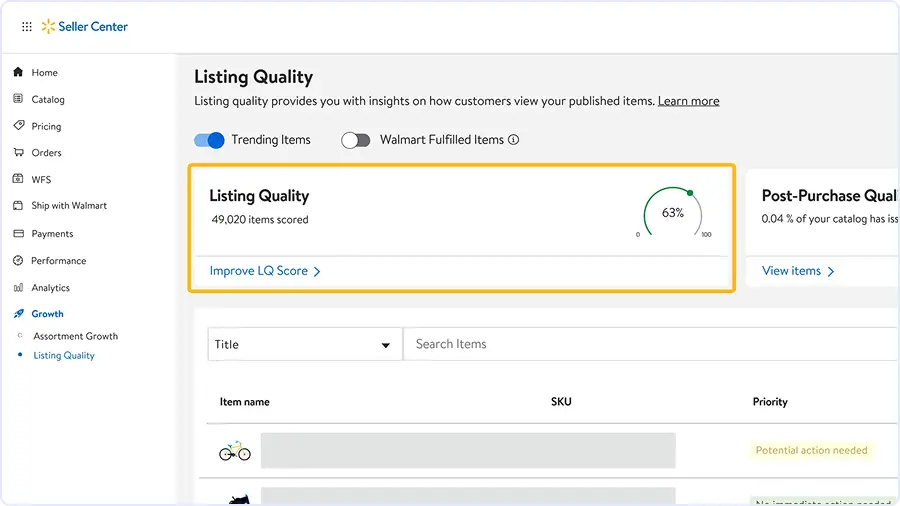
The score considers:
- Content and discoverability: Product name, description, key features, images, and attributes.
- Offer: Price, delivery speed, and in-stock rate compared with other offers.
- Ratings and reviews: The number of customer ratings and reviews for the product.
Start with your listing content. Seller Center shows missing information and areas you can improve, so you can work through them one by one.
Ratings and reviews take longer to build. You cannot buy them or selectively ask customers for them. Your main options are providing accurate listings, shipping orders on time, and using Walmart’s Review Accelerator program.
Advertising With Walmart Connect
Walmart Connect lets you pay for additional product visibility. Sponsored Search places products in search results, while Onsite Display and Brand Shop and Shelf cover other ad placements.
Some ad features require brand registration. Walmart Brand Portal does not register trademarks for you. You need an active trademark registered with the USPTO.
Walmart’s Brand Portal guide says the trademark must have a seven-digit registration number. An eight-digit serial number means the trademark application is still pending and does not qualify.
Once enrolled, Brand Portal lets you report copyright, trademark, patent, and counterfeit issues. It also gives you access to features such as a Brand Shop.
Advertising is separate from Walmart’s seller performance and policy systems. A strong listing and good seller performance do not exempt your products from Walmart’s other policies.
Common Walmart Seller Challenges and Solutions
Most Walmart Marketplace problems can be fixed. The first step is finding what caused the issue. A content problem and a pricing problem can look similar at first, but each needs a different solution.
The sections below explain the common issues and how to address them.
Listing Suppression and Unpublished Items
A product can become unpublished because of an issue with its content, price, or product information. This is different from account-level suppression, which affects all seller-fulfilled listings. WFS listings can remain active.
Solution: Open the Unpublished Items dashboard in the Seller Center. It shows why each item was unpublished, so you can fix the specific issue instead of rebuilding the listing. Many items republish automatically after you make the required fix.
Account Suspension and Appeals
A suspension removes your listings from Walmart.com, whether you fulfill the orders yourself or use WFS. Walmart sends an email explaining the reason and whether your account is eligible for an appeal.
Solution: Check your Performance page to find the metric or issue that caused the suspension. Then submit a plan of action through the Help button in the Seller Center. Termination is different. Walmart can send a termination notice without providing a reason, and terminated accounts cannot be appealed.
Walmart Pricing Rule Violations
Walmart can automatically unpublish offers priced well above the same item on Walmart.com or competing sites. It can also act on prices that appear to violate its pricing rules, according to Walmart’s pricing rules guide.
Walmart considers your item price and shipping fee together. So a low item price with a high shipping fee can still trigger a pricing issue.
Solution: Adjust your price toward the reference price shown on the Unpublished Items dashboard. An unpublished item may still be available through More Seller Options, so the offer can lose its main placement without becoming completely unavailable.
Return and Refund Losses
Returns can create unexpected costs for sellers. Customers can return many marketplace items within 30 days. A refund for an item reported as not received can leave you covering the product cost, outbound shipping, and the refunded sale.
The return reason affects who pays. In the example above, the item came back unsellable, but the customer selected “no longer want.” Walmart treated it as seller-at-fault, so the seller absorbed the loss.
Solution: Review your return reasons regularly. If a return was caused by Walmart, check whether you can dispute the charge.
Overselling and Canceled Orders
Cancellations can quickly push your account below Walmart’s performance standard. Overselling happens when an item sells on another channel after your Walmart inventory has run out.
Solution: Sync inventory across channels automatically, or keep a buffer for Walmart orders. This reduces the risk of selling more units than you have in stock.
Cash Flow in the First 90 Days
Your first orders can ship weeks before the money reaches your bank account. The new seller hold can make that wait even longer.
Solution: Plan restocking around your payout dates. This helps you avoid tying up cash in new inventory before your Walmart payments arrive.
The Future of Selling on Walmart Marketplace
Walmart continues to expand its marketplace, and its seller policies can change over time. Keep up with policy and fee changes before you build your selling strategy around them.
Marketplace Is Driving Walmart’s Ecommerce Growth
Global ecommerce sales grew 24% in Walmart’s fiscal year ending January 2026. Store-fulfilled pickup and delivery and marketplace were the main drivers, according to Walmart’s Q4 earnings release.
Walmart now reports marketplace as a separate eCommerce growth area. That makes marketplace an important part of its ecommerce strategy and helps explain the continued expansion of its seller programs.
What AI Shopping Agents Mean for Walmart Sellers
Walmart has built its own shopping agent, Sparky, and is integrating AI shopping into its customer experience. That means shoppers can discover products through AI-generated recommendations instead of browsing product pages directly.
- Listing data matters: AI tools can use product titles, attributes, prices, and other listing information to understand whether a product matches a shopper’s request.
- Reviews add context: Ratings and reviews give shoppers more information when comparing products, so keeping your listing accurate and your customer experience consistent still matters.
Both depend on the same foundation: a complete and accurate listing gives AI tools the information they need to understand your product.
Walmart Advertising Costs Are Rising
Walmart’s global advertising business grew 46% to nearly $6.4 billion in fiscal 2026, according to its Q4 earnings release. Walmart Connect in the US also grew 41% in the fourth quarter.
For sellers, that means more competition for paid visibility. Organic ranking still affects where your products appear, while advertising gives you another way to put products in front of shoppers.
Cross-Border Selling Through Walmart Exports
Walmart Exports lets eligible WFS inventory reach shoppers in Canada and Mexico. Walmart handles the international shipping, so you do not need to manage that part yourself.
Eligible products can be enrolled automatically, so you do not need to create separate listings for these markets.
Walmart New-Seller Savings Ends January 2027
Sellers who went live after February 1, 2026, can qualify for up to $75,000 in savings, according to Walmart’s program page.
- Referral fee discounts: Up to $72,000, with discounts of 20%, 30%, or 40% based on sales volume.
- WFS credits: Up to $2,000 through a 10% discount on fulfillment fees.
- Search engine marketing credits: Up to $1,000 after eligible ad spend.
- Walmart Connect ad credits: Up to $500 after enrollment.
You need to opt in. The offer does not apply automatically. Enroll from the Payments page after your store goes live.
The program ends on January 31, 2027.
Recommended Reading:
Conclusion
Selling on Walmart comes down to getting approved, setting up payments and shipping, building accurate listings, and meeting Walmart’s performance standards.
Your contract category determines your referral fee. Payment timing affects your cash flow, especially when you are new. Performance standards continue to apply after your account goes live.
It suits sellers who already have a track record and reliable fulfillment. With both in place, you can put new listings in front of Walmart shoppers without relying entirely on paid advertising.
The trade-off is ownership and control. Walmart sets the fees, rules, and how products appear on its marketplace. Advertising can also add to your costs.
Walmart is one sales channel. Your own store gives you more control over pricing, customer data, and how you run the business.
6Valley gives you that option. It works as a single-vendor store from day one and can switch to a multi-vendor model when you are ready. You can see how it works in the free 6Valley demo.
Start on Walmart while you learn what sells. Build your own once you know.
Frequently Asked Questions
How much does it cost to sell on Walmart Marketplace?
Selling on Walmart Marketplace costs nothing upfront. Walmart charges no setup fee and no subscription, and instead takes a referral fee out of each sale, set by the category your item falls into. If you use Walmart Fulfillment Services, you also pay per item shipped and for the space your stock takes up in the warehouse.
How long does Walmart Marketplace approval take?
Walmart approval has no fixed timeline. Business verification can clear in minutes when your documents match your official records exactly, and stretch into days when something does not line up. Walmart may also ask for extra paperwork or an identity check, which adds time.
Can individuals sell on Walmart Marketplace?
No. Walmart accepts registered businesses only, so an individual would need to register as an LLC, corporation, or partnership first. Non-profits are also turned away, along with sole proprietorships outside India.
When do Walmart Marketplace sellers get paid?
Walmart pays sellers every two weeks. An order becomes payable seven or more days after it ships, and settlement cycles close on alternate Fridays at midnight Pacific Time, according to Walmart’s payment activities guide. New sellers may have an additional hold of up to 14 days for US businesses or 21 days for businesses incorporated outside the US.
What happens if my Walmart Marketplace application is denied?
Walmart does not always explain the reason. The usual causes are a business type it does not accept, documents that do not match your registration, or too little selling history behind you. Once the cause is fixed, you can apply again.
Can international sellers sell on Walmart Marketplace?
Yes. Walmart accepts sellers from a specific list of countries, including Canada, China, India, Japan, Mexico, the United Kingdom, and Vietnam. International sellers do not need a US business tax ID and can use Walmart’s alternative verification process. They may also face a new-seller payment hold of up to 21 days.

Meet Shahebur Rasul, an electrical engineering graduate who chose to become a technical content writer. He loves to find concise insights from complex ideas. He uses his natural storytelling abilities to turn these insights into easy-to-understand content, even for non-technical people. When he is not writing, he watches or plays football.